Soliya reflection

Soliya was an international student conference where students from different parts of the world to share their experience and background about different topics. Unfortunately I was not able to participate this semester as my assigned group conflicted with other courses so I could not attend. However, I interviewed 2 students, attended a focus group where another 2 students talked about their experience and I attended another focus group that was about privacy.

People’s main comment about soliya was mainly about the assigned groups as some of the groups were more interactive than others which made the process a lot more fun and engaging while for those who had groups that did not interact found the whole experience not interesting and maybe for some people they thought that it was boring.At first most of my colleagues felt uncomfortable talking in front of people that they did not know then after several meetings with their groups they became more confident and willing to talk. The students that I interviewed said that they expected to talk about their cultures and countries but it wasn’t like that as the topics were about who they are, their interests, how do we see our cultures and what are their expectations and things that they’re willing to change from their culture stereotypes and traditions.

Other topics where about social media platforms and how much they are involved in their lives. We also talked about social media in the Google hangout that we did which was about privacy. We shared our stories and talked about funny things that happened to us while using social media platforms. The thing that I liked the most was the diversity of people and how interactive and understanding they were. I shared a story of mine which was about someone who created a fake account for me on a social media platform and how I dealt with it and most importantly I felt really comfortable talking and participating in the conversation which was something that I did not expect. Then, they all shared similar stories and experiences about how could people use social media to invade others privacy and how can we protect our identity on social media platforms to avoid any unwanted consequences.


Final reflection

Being one of the most interesting courses that i have ever taken this course was quite interesting and beneficial for me at the same time as almost all the classes were really fun and the topics were very engaging.

The first thing that i learnt from the course is blogging since it was my first time to write and know what a blog post is and it was something that I truly enjoyed, especially when I did the game blog post and found that a lot of people where commenting on the blog post and interacting with it. It gave me a motive to work when I felt like I had audience and that people where looking forward to play it.

Secondly, I guess this course have changed my way of thinking about several topics like when I hear others way of thinking and perceiving problems. One of the topics that I feel like I have learnt from was when we talked about equity and when we learnt how not to judge people based on what you heard about them but based on your own experience and to keep an open mind when it comes to accepting other people’s beliefs and opinions. I also loved the freedom of speech that was provided by Dr Maha where she left us to express our thoughts and opinions freely with no borders or restrictions which gave me the confidence and courage to participate and reflect on every topic with enthusiasm.

Lastly, another major thing that I have learnt was to use google docs to create the game which was also a new experience and a platform that I have never used before and it was easy and flexible to use and most importantly a new skill that I have gained from the course. Apart from that the games that we played made me learn how to put myself in other people’s shoes and experience things from their own perspective.

In general Dr Maha’s attitude helped me learn a lot throughout the course as she was very cooperative and understanding and she made it easy for us to approach her and speak out if she has any problems. Also, the variety of the ways that we learnt through from videos, readings, games and debates and that was the key element that made the course interesting and beneficial.

My only suggestion to improve the course is to include more in class activities as they make the students feel more engaged and remember and learn more from every topic. Also, maybe decreasing the in class readings and the amount of blog post and make it after every major topic instead of  the many blog posts after each class.

Contribute Assignment

For my contribution assignment, I was choosing between the topics that interested me the most, which are fake news and privacy. I watched a couple of videos about both topics and found a couple of interesting videos that can be added to the content of the course.

The first video is a TED-Ed animation video  about fake news and it explained the concept really well, along with that there was a quote that said “A lie can travel half way through the world while the truth is putting on its shoes” which shows us how fast a piece of fake news can spread compared to another one that’s true. Also, it added a new term to my knowledge known as circular reporting which is like what happened with the NASA girl, where a source publishes something then another one takes it and the first publication cities the one who copied as the source for their information; or when multiple sources uses the same source to report something that’s not true. Moreover, sometimes something that was approved by an a credible person may be taken seriously without checking this person’s sources. Another form is when people get information from a Wikipedia source that they are not sure if it’s true or not just because it’s quick and convenient for them.

The second and third one are just funny light videos about privacy where it shows how could the technology steel your information without you noticing it and how could companies and institutions use this information against you as sharing your personal life can affect your professional life Therefore, you should take good care about what you post online so that you can protect your privacy.

Curation: Fake news

When using the social media platforms or the internet in general as a source of providing news you must be really careful as its not monitored by anyone, and the fact that it spreads quickly and everyone is talking about it does not mean that it is true. So, when it comes to getting news from the internet you should always double check the reliability of the source and we shouldn’t always believe what’s told to us or even what we see as there is a high probability that it’s going to be fake news. We learnt more through the article from the Mozilla Health report article and the presentation done in class by some colleagues.


The first thing that we saw about fake news was that video for Donald trump in the White house that contained a picture of Muslims and the “Kaaba” where he said that it is like the sea of love where you would assume that he’s praising Muslims while in fact he was just praising himself which we discovered after viewing the original video that showed us that that he was talking about people came from all over America to vote for him and how much love they have for him and that what he described as “Sea of love ”. When seeing the video, I didn’t think twice and that was because of the credibility of my professor, I thought that she would never show us something fake and it was also a video with trump’s voice so how could it be?

We were then assigned to play a game called “Fake it to make it” which let you discover the effect of fake news more closely. First I knew how easy it is to create a fake account or even a website, share fake news with people and get money out of it. You were asked to spread fake news through a blog that you created, you have to make it sound and look credible and only use it for spreading fake news that will make you gain money and credibility from people. Which leads to the conclusion that people tend to believe things that the see or watch without questioning its credibility which makes it easier for people to spread fake news and that is something that they can benefit from in so many ways.

Moreover, the most recent and viral fake news in Egypt belonged to a girl named Sarah abu elkheir who’s also known among people as “The Nasa Girl”. The story started when she posted a video saying that why not create a giant BBQ under each rocket that’s launched by NASA, you can imagine how silly this may sound however, she photoshoped NASA’s official account replying to what she said saying how awesome her idea is and how exciting it is to try her idea in their next launch. Then she continued what spreading fake news through her Instagram account, including more famous companies and celebrities like Buzzfeed, Spacex, Netflix and Ellen which made her more famous everyday by doing that. She increased her number of followers, got offers from a lot of other companies offering her gifts and even money! Also, a lot of reputable TV channels newspapers and magazines took the news and they spread it out and she was on every social media platform and none of those people referred back to her to ask her if that was true or not. She ended it after almost a week saying that it was part of a social experiment which was a shock for everyone even for some people who know her including myself.The only company who contacted her directly was called Binge circle, and that was when the truth finally revealed through the video that Sara explained the whole story.

A famous online magazine in Egypt called Scoop Empire’s article https://scoopempire.com/this-arab-girl-received-offers-from-nasa-spacex-netflix-buzzfeed-and-we-couldnt-help-but-step-in/


The following class the Dr gave us some pieces of information to look up and see if they’re real or fake and it was not easy to be honest. A couple of them was “Is the Sun going to sleep in 2020? Will there be a mini ice age?”  That topic specifically is one that people would spread fake news about maybe because it concerns people a lot or because of how fast it spreads. The results were shocking as we found websites that made us feel more skeptical about that news, and it was very hard to prove whether they are fake or not. Also, there was that website that had statistics and facts that looked scientific so that we couldn’t prove that it was not true. Here’s the link where they said that the world would end in 2020 because of a mini ice age https://tfrlive.com/is-there-going-to-be-a-mini-ice-age-the-sun-going-to-sleep-has-scientists-suggesting-so/ . The website has everything to offer from resources, scientists names and name of scientific institutes. After a couple of minutes searching online, a couple of people found out that it was fake as none of the links that were attached to the website worked.


Another one was “Is Paracetamol Contaminated with the Deadly Machupo Virus?” Here: https://www.snopes.com/fact-check/paracetamol-warning/. Where we found it really easy to know that it was fake, the first source that I opened showed that it was a claim. Also, the Dr showed us an easy way to spot fake news which was through typing “hoax” next to what we want to know. Furthermore, there’s a website that checks for the credibility of sources called Snopes that might help you in recognizing websites easily and efficiently.


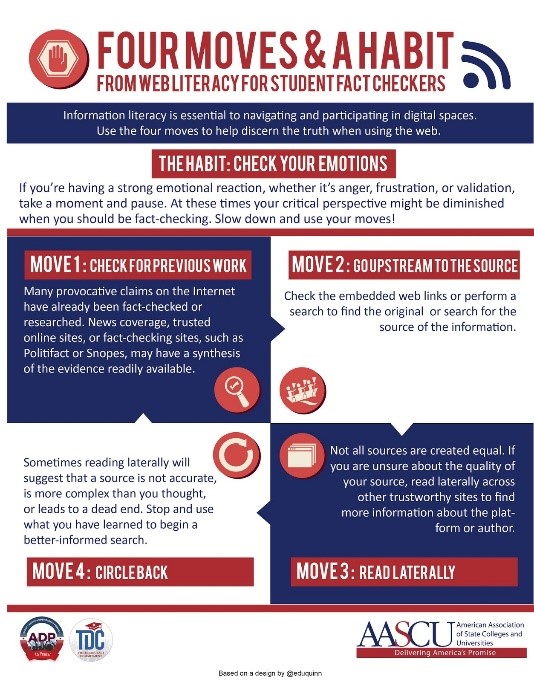
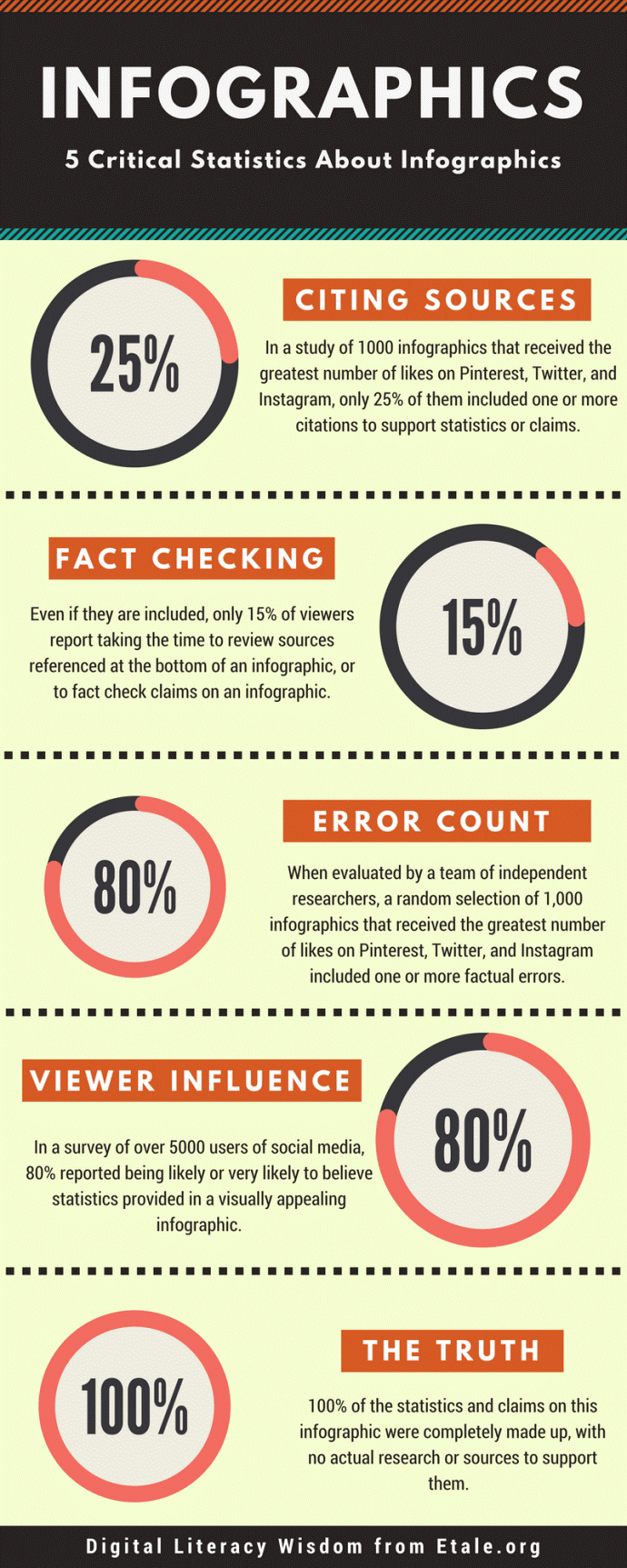
Moreover, we discussed an article called “5 Statistics about infographics” which fooled most of us as it had a picture that included statistics and percentages that looked realistic and grabbed our attention then at the end it claimed that all of that was fake and that took us to the four moves by Michael Caulfield:  which are the four steps that you should do to check the credibility of a source which are:

  • Check for previous work: Look around to see if someone else has already fact-checked the claim or provided a synthesis of research.
  • Go upstream to the source: Go “upstream” to the source of the claim. Most web content is not original. Get to the original source to understand the trustworthiness of the information.
  • Read laterally: Read laterally. Once you get to the source of a claim, read what other people say about the source (publication, author, etc.). The truth is in the network.
  • Circle back: If you get lost, hit dead ends, or find yourself going down an increasingly confusing rabbit hole, back up and start over knowing what you know now. You’re likely to take a more informed path with different search terms and better decisions.


Then we tried applying them to some other pieces of news so they made it easier for us to spot fake news.
BA

To sum up, fake news is a very critical topic that people need to be more educated about as it can affect many aspects in their lives, it could provide them with wrong information and concepts. Therefore, educating people about the importance of checking the credibility of their sources would result affect them tremendously while doing any research or searching for information online.
 

Game final draft

Based on my experience at university and the continuous stress that I always have to deal with, I chose that my game would be about stress. All the scenarios of the game are real ones that I face whenever we’re approaching the midterms or finals period where it’s hard for me and many of my colleagues to manage our times and live our lives normally. The scenarios may sound extreme to some people but believe me that is exactly what happens when that time of the semester approaches, it’s when you find each architecture student grumpy, sleep deprived and over stressed. That is exactly what this game is about it shows you a glimpse of our lives as architecture students; most of the situations that are in the game happened to either real people or to myself. You can try to play the game here!


https://docs.google.com/forms/d/e/1FAIpQLSf2XU9IvAh1_5Sb–DyCXelKyKNfSu3foeb1GA8WrjKGfpCXw/formResponse


First draft:

https://docs.google.com/forms/d/e/1FAIpQLSf2XU9IvAh1_5Sb–DyCXelKyKNfSu3foeb1GA8WrjKGfpCXw/viewform?usp=sf_link


Initial game idea:

https://wordpress.com/post/hana.travel.blog/24


Since the beginning of the process of making the game, the feedback was that the choices lead to extreme cases that always have bad consequences and that was the main intention of the game. As its purpose is to deliver our experience to people where we would always have to sacrifice something in order to get something else and you have to try and make the best of the worst choices that you have based on your priorities at that time and you could always mess it up with bad decisions and whenever you think that you’re doing the right choice you would have to lose something in return.


What I would do if I had more time is conducting more interviews with architecture students so I can know more situations where they were stressed and had to make life changing decision and how did these decisions affect their lives. The most important thing that I have learnt from my interviews with students is that everyone perceives things differently some people can actually perform better when they are under stress while for others who can’t deal with stress, it can drag them down as they just can’t handle it or work under such a draining pressure.

Do Not Track!!

Overall, the videos that I have watched were pretty shocking and as I watched more episodes it became really scary how simple actions like the clicks that you make and consider part of your daily routine can affect your life! As websites can track you, know where you go, where you live and a lot other confidential information about you. Not only that but also, they share this information with other websites so that the can know your preferences and use it for their own benefit without taking your permission which is something that I have found very annoying even though I don’t really post anything personal on social media platforms, the fact that my information is being used without my permission is itself bothering me.

The spy in my pocket series showed how can apps use your information and get things from your phone without you noticing, like for example the angry birds game which is in fact a very silly game that went viral and was on each and every phone. It was found out that it uses information about you from your phone like accessing your contacts for example which is very shocking. As it is the kind of app that you might think is very silly and somehow useless, it could take your personal data and share it with other people who might use it in advertising something for you through the app for example.

Also, the morning rituals should us how dangerous it is to be addicted to social media platforms and posting details from our daily lives that could be used to know things about our personal lives, help google and other applications in tracking our history and it isn’t the website that you’re visiting but a couple of other parties that are watching you and use that data for advertising purposes which use cookies to record your activity and use it for their own good where they can collect tons of money out of this information. Therefore, they analyze everything about you, what you love, what you hate, your personality traits and based on that they choose the suitable ads for you so these ads are not just random ones that appear to you but instead they are specifically tailored to suit your preferences that these advertising companies know what they are without you telling them. Finally, the internet experts’ advice is that we should try to protect our digital selves as much as we protect ourselves in real life.